
Spotlight on newspaper strip layout
The creators
The writer
The author's task was to write a manuscript. Lee Falk wrote the script with dialogues and narrative text, also with a description of the scene and other instructions for the cartoonist. When one read newspaper comics in old newspapers from the 30s and 40s many newspapers had a by-line over the strip: Mandrake the Magician short title by Lee Falk and Phil Davis. This short title is the same in different newspapers on the same day. But this short title is not found at any original art, so most likely it is not written in the script.
One of the few scripts still in existence is from October 27 1996, a page from the Phantom Sunday story "The Lookout". note: The pencil sketches in the script were made by George Olesen.
-
 script 1996
The Phantom -
 the page


The artist
The artist's task was to draw the newspaper comic stripes in high contrast, with black ink on white paper.
By studying original art created by various newspaper comic artists, one sees that the daily strips have a blue color were a dotted pattern later is glued on. This pattern is known as Ben-Day dot pattern or later as Zip-A-Tone, to create a halftone effect. One do not see a corresponding blue color or halftone pattern on the Sunday pages. Nor do one see any hints that the artist envisages which colors will be used on a Sunday page. A small exception can be seen on the back of Alex Raymond's third Flash Gordon page. A small note is written with a typewriter: Note to color man - it is very important that the skin of the inhabitants of the new planet be given a blue tint insted of a flesh tint
In both the dailies and Sundays there is glued on a small copyright mark. The sundays often has a logo glued on the strip.
It has not been established whether it was the artist himself who applied the blue colour on the dailies. But it is unlikely that the artist himself glued on the dot pattern, the copyright mark or the logo.
-
 a strip from 1935

King Features Syndicate
The staff
At KFS, a staff was employed to prepare the cartoon artists' drawings so that they could be printed in the newspapers. Such a staff was later in the Marvel universe known as the bullpen.
The preparing was correcting misspellings, (adding blue color as guide for the half tone pattern on the dailies ?), adding the half tone pattern on the dailies, glue on copyright label, adding a logo to the Sunday pages. adding colors for the Sundays - for later color separation. Since the daily strips and Sunday pages was to be printed in slightly different proportions is it possible that part of this work had to be done for each individual variant.
KFS established[1] its foreign department in 1928 and by[2] 1940 they sold their features in 90 countries and in 30 different languages. By 1946 comics and other features for Latin America were[3] largely translated in New York, then carefully checked in the local syndicate offices for embarrassing idiomatic errors. For Scandinavia the translation of comics were chiefly done in the syndicate's offices by Erwin Falking who had translated and frequently rewritten them since 1931.
Final product to be sold to the newspapers
As shown later, some variants of the dayily strips before 1954 were adjusted/trimmed in height. Otherwise, the original drawings (with the additions by KFS staff) were used in the further process. These processed strips by the KFS staff were then photographed and the negative was scaled down to the size they should have and transferred to a zinc plate via an etching process. This zinc plate became the master for making the matrix and proof sheets that was sent to the newspapers weekly.
The proof sheets consisted of six strips (a week) that the largest newspapers used to create their own master zinc plates as described above.
The matrix (mat (also known as a flong)) is is a mold made of a soft cardboard-like substance. The smaller newspapers could pour liquid lead into them and make their own printing plates, and thus were not dependent on having equipment to make their own master zinc plates.
-
![1936: The Phantom 6 columns[footnotes 1]](/images_mandrakewiki/thumb/f/f8/KFS-Proof-tP-1936.jpg/88px-KFS-Proof-tP-1936.jpg) 1936: The Phantom
1936: The Phantom
6 columns[footnotes 1] -
 1946: Mandrake
cropped -
![sample[footnotes 2]](/images_mandrakewiki/thumb/5/53/Cherry-matte.jpg/120px-Cherry-matte.jpg) sample[footnotes 2]
sample[footnotes 2] -
 Swedish plate for April 28, 1949 daily strip (story The Amazing Ray).
![1936: The Phantom 6 columns[footnotes 1]](/index.php/File:KFS-Proof-tP-1936.jpg)

![sample[footnotes 2]](/index.php/File:Cherry-matte.jpg)

In 1940 the daily comics were[4] supplied in matrix or proof form, in 5 or 6 columns (with a few exceptions for certain titles). The Sunday strips were available in matrix form in one to four colors, or black and white.
In addition, KfS offered readyprints because some newspapers did not have sufficient color-printing facilities or because they found it less expensive. The King Features readyprint comic sections were available in 4, 8, 12, 16 and 24 pages, with choice of comics.
Newspapers - layout
In 1934 a standard broadsheet newspaper page consisted of eight[footnotes 3] columns separated with gutters, an empty space of about 10 to 12 points (a pica is 12 points = 1/6").
Daily strips
The first Mandrake story was offered by KFS to the newspapers in a format spanning 6 columns, about 3" x 12". A five-column variant (about 2 1/2" x 10") was also offered not long after[footnotes 4].
In the beginning, the only difference between the 6-column and 5-column variants was that they were scaled to fit over six or five columns on a newspaper page.
On the twentieth of April 1942, the 6-column variant is replaced by a 4-column variant. Later that year (from October 12, 1942) there is a change in the aspect ratio so that the 4-column variant is taller than before. For the week of October 12, the 5-column variant is similar to the original drawings by Phil Davis, while the 4-column variant has the side of the panels cut down to fit the new format. From the following week (week of October 19) the 4-column variant is similar to the original drawings by Phil Davis, while the 5-column variant is cropped in the lower part.
-
 original art
aspect ratio -
 October 10, 1942
 -
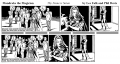 October 12, 1942
 -
 October 19, 1942


In 1946, KFS also began to offer a 3-column variant, spanning three columns where the strip is divided into two rows. It is not known the exact date when this variant became available for the Mandrake stripes. But if one looks at the Mandrake strip in the "San Francisco Examiner" they printed the 5-column variant in two rows, spanning 2.5 columns. When "the Jinx" started it was in this format, but on Friday that week the strip spanning three columns and the panels is edited wider and stands out from the other variants. In the "San Francisco Examiner" the last edited 3-column variant is on January 18, 1947. At this time (see newspapers.com), two other newspapers also had the Mandrake strip in two rows spanning 3-columns: "Pittsburgh Sun-Telegraph" with a up-scaled 5-column variant and "St. Louis Post-Dispatch" with a in-house version of the 4-column variant.
From the 29th of July 1948 the Mandrake strip in "Pittsburgh Sun-Telegraph" looks like the 3-column variant that was printed in the "San Francisco Examiner" and is edited wider standing out from the other variants. The 3-columns is less cropped in the lower part (compared to the 5-column variants) and the copyright line and the date can be placed differently in the strip. The last strip in this variant is on April 8, 1950.
-
 June 7, 1946
 -
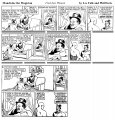 June 7, 1946


Fewer newspapers printed the Mandrake strips in the 3- and 5-column variant and during 1954 these disappeared and KFS only offered the 4-column variant to its customers.
When you look at newspapers on newspapers.com, which mainly originate from microfilm, you discover that the strips can have different aspect ratios then Phil Davis original art. If you scale an image obtained from such a source and scale it to the same width as an original drawing, you discover that the image from the microfilm may be slightly higher or lower than the original drawing.
Looking at the twentieth and twenty-first annual directory of syndicates and features in Editor and Publisher (1945 and 1946) the daily strips are listed with size, columns wide and inches deep. The height of the Mandrake dailies are:
- 3c = 4 3/4"; 4c = 2 7/16"; 5c = 2 1/4"
The height of the four-column variant is similar to most other newspaper comics at that time. But the height of the five-column variant varies slightly like: "The Phantom" - 2 7/16", "Secret Agent X-9 - 2 9/16", "Rip Kirby" and "Buz Sawyer" - 2 13/16".
Lee Falk's other comic strip, The Phantom had a corresponding development in size. It started spanning 6 columns in 1936, and 5 columns variant was added in 1939. In 1942 there was only 4 and 5 columns variant. A 3 columns variant was added in 1947. Then, from 1953 there was only the 4 and 5 columns variants.
Sunday pages
The Sunday pages was intended to be printed in the comic section (a supplement magazines) for the Sunday (or Saturday) edition of the newspapers.
The Sunday pages were sold as furnished in mat form complete. These are cardboard molds that were sold to the newspapers, which then poured liquid lead into the molds to make the printing plates. If they were to print the strip in color they used four printing plates. One for red, one for yellow, one for blue and one for black.
The size of the main newspaper was known as Broadsheet and measures about 29.5 inches × 23.5 inches. The supplement magazines were in two different size[footnotes 5]: Full page which is 22 inches × 14 inches and Tabloid which is 14 inches × 11 inches. So, if you take a tabloid, unfold it and rotate it 90 degrees, you have roughly the size of a comic section standard page.
Some of KFS's Sunday strips were made to fill an entire page in both a tabloid and standard sized comic section like the two strips by Alex Raymond, "Flash Gordon" and "Jungle Jim". By rearranging the panels, these were sold as a full page "Jungle Jim"/"Flash Gordon" or two tabloid pages, one with "Flash Gordon" and another with "Jungle Jim".
-
 February 3, 1935
Flash Gordon -
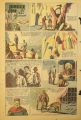 February 3, 1935
Jungle Jim -
 February 3, 1935
full page -
 June 16, 1935
full page vs tabloid


As shown in the Sunday page from June 16, 1935, it could sometimes be a challenge to adapt the original drawings to the tabloid format.
Tabloid page
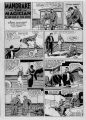
From the beginning the Mandrake Sunday pages were sold to fill a tabloid page.
-
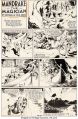 August 6, 1938
Mandrake original -
 May 5, 1940
 -
 May 5, 1940
reduced -
 May 5, 1940
extra ink


There are some variations in some newspapers that differ in size, which appears to be done locally in that particular newspaper. Some panels may be cut slightly at the bottom of the panel to reduce the height, to make room for an advertising banner or something else. But also variants with extra ink on the sides to make the page wider.
Tabloid and standard half page
In 1942 KFS started to offering the Sunday page also to fit a standard half pages. Phil Davis changed his layout so that the originals were drawn three rows high, so that they could be split into a landscape format two rows high. The last page made that could not fit the half page format was on April 26, 1942.
-
 April 26, 1942
tabloid -
 June 7, 1942
tabloid -
 June 7, 1942
half page


Tabloid, half and third page
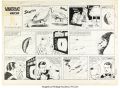
On 6th of August 1961 a third variant turn up and the Sunday page was now sold in three different formats: tabloid page, standard half page and standard third page. For the Mandrake Sundays this third page was made by dropping the first row of a half page (known as "throwaway" panels). Phil Davis had until now drawn in a portrait format similar to what a tabloid page looked like. When the third page format was introduced Davis changed his layout to the landscape format, so that his original art looked like the half page. Interesting, the size ratio of the original art is not the same as when the strips were printed in the newspapers. If you compare panels from an original drawing by Phil Davis, you see that in the tabloid version the panels are pressed together in height, but in the half and third pages the panels are stretched higher.
-
 August 6, 1961
original -
 August 6, 1961
half and third page -
 August 6, 1961
tabloid -
 October 29, 1972
half and third page -
 October 29, 1972
tabloid


This new format also meant that there was room for a new logo for the half-page variant. The subtitled "By Lee Falk & Phil Davis" changed to "By Lee Falk" on June 27, 1965 - which is the first time we can see Fred Frederick's name on a Sunday strip. On the strip of June 7, 1970, Fred Fredericks start changing the panel size in his layout. This led to a new logo being created for the half-page variant.
-
 from August 6, 1961
 -
 from June 27, 1965
 -
 from June 7, 1972


Half and third page
Late 1972[footnotes 6] the Sunday page was sold only as standard half page and standard third page. For the Mandrake Sundays this half page was made by dropping the first column of a third page. Comparing an original drawing by Fred Fredericks, the third pages are closest to these. The panels in the half-page version are stretched higher.
-
 October 5, 1972
half and third page

In 1984 the Sunday page was sold as: standard third page, tabloid half page and the small quarter half page. The quarter half page is the same as the third page, but only fills about two-thirds of the width of a newspaper page. The newspaper page could then have four strips in height, as well as room for something else in the remaining space.
The Phantom
Lee Falk's other comic strip, The Phantom had a slightly different development in size. Ray Moore and Wilson McCoy drew the Sunday pages in landscape format, close to the half page format in the newspapers. The KFS staff rearranged the panels to fit a tabloid format and added some extra ink to some of the panels. So, when the Phantom Sundays started in 1939 it was sold in two different format: standard half page and tabloid page.
By 1943 it was sold as: tabloid page, standard half and third page. The panels are almost identical at the tabliod and half page variants. The third pages (earliest known is from May 2, 1943) are cut in the lower part to make them lower in height, and there are some extra ink on the sides of individual panels to make them wider.
By 1946 there are only standard half and third pages, adding a tabloid page again in 1948. (was there a tabloid vesion from August 4, 1946 to April 4, 1948 ?)
A fourth variant turned up in 1966, the small quarter half page. Then a fifth variant in 1971, the tabloid half page.
Note
- All the products that were made in the process of printing the strips in the newspapers, as well as the newspapers themselves, were counted as fresh produce. Very few products exist today: only a few original drawings, a few molds, a few printing plates, etc.
- ↑ *picture from PhantomRayMoore
- ↑ *picture from Stripper's Guide
- ↑ 9 columns at pages with small ads
- ↑ the five column variant existed in January 1935
- ↑ The size is stated slightly differently in relation to which sources one uses. This article takes the starting point in sizes mentioned in Andy Madura's Comics & Paper Collectibles
- ↑ the last known tabloid page is from October 29, 1972
References
- ↑ Canel, Vic, "Good Grief, Carlitos, Snoopy Speaks Spanich!", The Panama Canal review (Fall 1973), p. 7
- ↑ The Blue Book of King Features Syndicate, Inc. July 1, 1940
- ↑ Stauton, Helen M., "Feature Development for Overseas Seen", Editor and Publisher, 18 May 1946 (Vol 79), p 32
- ↑ King Features Syndicate Inc., July 1, 1940
Sources
- Archive.org: Editor & Publisher 1901-2015 information for the size and years of the Mandrake strips from "Editor and Publisher", Annual directory of features - Newspaper art features: years 1934-1942, 1945-1959 and 1961-2010.
- The Stripper's Guide Dictionary Part 1: Sunday Strips
- Glenn Fleishman: From Artist’s Board to Newspaper Page: How Comics Were Made in the Age of Metal Printing, 1910s–80s YouTube
- Heritage Auctions: Sold original art
- Legion of Andy: BEN DAY DOTS Part 8: 1930s to 1950s—the Golden Age of Comics