
King Features Syndicate: Difference between revisions
Tag: Manual revert |
|||
| (9 intermediate revisions by 2 users not shown) | |||
| Line 1: | Line 1: | ||
'''King Features Syndicate''' is a print syndication company that distributes comic strips, newspaper columns, editorial cartoons, puzzles and game to newspapers around the world. | '''King Features Syndicate''' is a print syndication company that distributes comic strips, newspaper columns, editorial cartoons, puzzles and game to newspapers around the world. | ||
It started in 1895 when newspapers own by William Randolph Hearst began syndicating material. In 1914 all of Hearst's syndication enterprises were consolidated under one banner, "King Features Syndicate". | |||
William Randolph Hearst | |||
The Foreign Sales Department of KFS, INS<ref group="footnotes">INS - International News Service</ref> and INP<ref group="footnotes">INP - International News Photos</ref> was<ref name="ep85-35">"KFS Foreign Sales Staff To Convene in New York", ''Editor & Publisher'' 13 Sep 1952, Vol 85 Iss 38, p 70</ref> the idea of J. D. Gortatowsky, King's business manager. He brought back the idea returning<ref>"Gortatowsky Returns", ''Editor and Publisher'', 14 Jul 1928, Vol 61 Iss 8, p 30</ref> from a vacation in Paris in 1928, where he had<ref>"King Features to honor pioneer in international sales arena", ''Editor and Publisher'', 7 Oct 1978, vol 111 iss 40, p 42</ref> meet the young journalist [[Paul Winkler]]. | |||
Gortatowsky became<ref name="ep85-35">"KFS Foreign Sales Staff To Convene in New York", ''Editor & Publisher'' 13 Sep 1952, Vol 85 Iss 38, p 70</ref> president of the three Hearst divisions and John A. Brogan, Jr. became vicepresident and director of foreign sales for all three divisions. At the time of its organization the department had seven foreign clients, all but two of them in Latin America. In the beginning the marked was limited to text features. | |||
==Newspaper Comics== | |||
===Distribution and licensing outside the U.S.=== | ===Distribution and licensing outside the U.S.=== | ||
====Americas==== | |||
====Europe==== | ====Europe==== | ||
*[[Bull's Presstjänst]] | |||
*[[Opera Mundi]] | |||
====Other ==== | |||
===Notes=== | |||
<references group="footnotes" /> | |||
===References=== | |||
<references /> | |||
==Comic books== | ==Comic books== | ||
| Line 87: | Line 93: | ||
===Various Documentation=== | ===Various Documentation=== | ||
<gallery> | <gallery> | ||
Image:At-KFS-party. | Image:At-KFS-party.jpeg|''Lee Falk with Jimmy Hatlo, creator of the comic strip "They'll Do It Every Time", at a KFS party.'' | ||
Image:KFS-1945 ceremony.png|''Newspaper article / Tribute to KFS ex-Président, with drawing presentation held on July 9, 1945'' | Image:KFS-1945 ceremony.png|''Newspaper article / Tribute to KFS ex-Président, with drawing presentation held on July 9, 1945'' | ||
Image:1947 ad.jpg|1947 Ad. | Image:1947 ad.jpg|1947 Ad. | ||
| Line 101: | Line 107: | ||
Image:program Friars ceremony.jpg|''page from the program of May 13, 1972 "Friars Ceremony" honoring Jack Benny and George Burns'' | Image:program Friars ceremony.jpg|''page from the program of May 13, 1972 "Friars Ceremony" honoring Jack Benny and George Burns'' | ||
</gallery> | </gallery> | ||
==External links== | ==External links== | ||
Latest revision as of 17:34, 20 July 2025
King Features Syndicate is a print syndication company that distributes comic strips, newspaper columns, editorial cartoons, puzzles and game to newspapers around the world.
It started in 1895 when newspapers own by William Randolph Hearst began syndicating material. In 1914 all of Hearst's syndication enterprises were consolidated under one banner, "King Features Syndicate".
The Foreign Sales Department of KFS, INS[footnotes 1] and INP[footnotes 2] was[1] the idea of J. D. Gortatowsky, King's business manager. He brought back the idea returning[2] from a vacation in Paris in 1928, where he had[3] meet the young journalist Paul Winkler.
Gortatowsky became[1] president of the three Hearst divisions and John A. Brogan, Jr. became vicepresident and director of foreign sales for all three divisions. At the time of its organization the department had seven foreign clients, all but two of them in Latin America. In the beginning the marked was limited to text features.
Newspaper Comics
Distribution and licensing outside the U.S.
Americas
Europe
Other
Notes
References
- ↑ 1.0 1.1 "KFS Foreign Sales Staff To Convene in New York", Editor & Publisher 13 Sep 1952, Vol 85 Iss 38, p 70
- ↑ "Gortatowsky Returns", Editor and Publisher, 14 Jul 1928, Vol 61 Iss 8, p 30
- ↑ "King Features to honor pioneer in international sales arena", Editor and Publisher, 7 Oct 1978, vol 111 iss 40, p 42
Comic books
KFS made an effort to publish comic books of its own by establishing the publishing company King Comics in 1967. This short-lived comic book line showcased King's best-known characters in seven titles: Beetle Bailey, Blondie, Flash Gordon, Jungle Jim, Mandrake the Magician, The Phantom and Popeye.
-
 promotional poster
-
 King Comics vignette for postage sending


Promotional material
Blue Books
The "KFS Blue Books" (first edition published in 1943) were sent out to newspaper editors only, not the general public. It was used to promote all of the daily and Sunday comic strips available from King Features as well as other columns, articles and puzzles. The books contains black and white daily strips and full page, colour Sunday samples for every comic character available at the time as well as samples of other articles and columns.
-
 Blue Book (1943)
-
 Blue Book (1946)
-
 Blue Book (1949)
-
 Blue Book (1954)
-
 Blue Book (1955)
-
 Blue Book (1961)


Famous Artists & Writers
"Famous Artists & Writers of King features syndicate" is a limited distribution as sent to newspaper comic editors. It was copyrighted by Melvin Leighton Heimer on April 22, 1946 (second time on February 12, 1947). The promotional book measures about 18x25.5 cm and has a five page introduction thoroughly detailing KFS, followed by short bios for 50 comic strip artist and 17 feature writers, in total of 129 pages. Each bio spanning two pages and includes a photo of the artist as well as a specialty art piece. The five page introduction and the bio pages are written by Mel Heimer, television and New York columnist for King Features Syndicate,
A second edition of "Famous Artists & Writers of King features syndicate" was printed in 1949. It is a bit larger (about 21.5x28 cm) and has 172 pages in total. Comparing the Phil Davis bio, the 1949 edition has a different photo, sample of art and the text is also rewritten.
Among the cartoonist featured are: Milton Caniff, Roy Crane, Phil Davis, Walt Disney, Lee Falk, Charles Flanders, Hal Foster, Frank Godwin, Fanny Cory, Mel Graff, Jimmy Hatlo, Syd Hoff, Fred Lasswell, Otto Messmer, George McManus, Frank Miller, Ray Moore, Mac Raboy, Alex Raymond, Bob Ripley, Otto Soglow, Walter Winchell, Chic Young, Bill Zaboly and others.
-
 Famous Artists & Writers (1946)
-
 Lee Falk
-
 Phil Davis
-
 Famous Artists & Writers (1949)
-
 Lee Falk
-
 Phil Davis


The World's Greatest Comics
These spiral bound books contain a number of KFS's famous cartoons: Beetle Bailey, Betty Boop, Blondie, Boner’s Ark, Bringing Up Father, Dooley’s World, Felix the Cat, Flash Gordon, Hagar The Horrible, Hi and Lois, The Katzenjammer Kids, Mandrake the Magician, Nubbin, The Phantom, Prince Valiant, Quincy, Redeye, Rip Kirby, Secret Agent Corrigan, Tiger, Tumbleweed and Wee Pals.
There are two different editions of this book, which measures approx 21.5 x 28 cm. The first is believed to be from 1974 and has 22 pages. The other containing 26 pages and has copyright information and the year 1975 printed on the inside front cover.
-
 1974
-
 Mandrake
-
 1975
-
 Mandrake


Promo Booklets
-
 1961
-
 1961 inside
-
 1966
-
 1969
-
 1969 inside


Christmas Presents - Promotional Items
Every year, KFS sent out a small Christmas present to newspaper editors and other customers. Many of their most famous cartoons were depicted on these gifts, a few also "Mandrake the Magician".
The Christmas card sets from 1939 and 1951 both contain a card with a picture of Mandrake. "A Christmas Carol", the 159 page book from 1946 has illustrations by Hal Foster, where Mandrake is part of a larger drawing with many KFS characters. "Sing with King at Christmas" from 1949 has 16 pages with carol music and lyrics. Mandrake only appears on the cover and inside each page has color art with various characters. In 1962 the Christmas gift was a mini-stapler with a blue thumb tip and enameled on the top with the characters: Dagwood, Beetle Bailey, Popeye, Donald Duck, Jiggs and Snuffy Smith. Mandrake only appears on the lid of the box.
-
 1939: Merry Christmas
-
 1951: Popular Comics
-
 1946: A Christmas Carol
-
 with Mandrake
-
 1949: Sing with King at Christmas
-
 1962: Stapler


Various Documentation
-
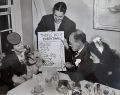 Lee Falk with Jimmy Hatlo, creator of the comic strip "They'll Do It Every Time", at a KFS party.
-
 Newspaper article / Tribute to KFS ex-Président, with drawing presentation held on July 9, 1945
-
 1947 Ad.
-
 1967 Advertissement
-
 1977 KFS Microfim Catalogue / Cover
-
 1977 KFS Microfim Catalogue / presentation page
-
 1979 KFS Catalogue / Cover
-
 1979 KFS Catalogue / inside page
-

-
 King of the Comics - 100 Years of King Features (Back cover)
-
 King of the Comics - 100 Years of King Features (inside presentation)
-
 1967 Advertissement / KFS has a lot of characters...
-
 page from the program of May 13, 1972 "Friars Ceremony" honoring Jack Benny and George Burns


